

Introduction
When asked to calculate the area of regular shapes like rectangles or circles, you can use the formulas l x w or πr2 .
However, how do you solve Physics questions that ask you to compute for the area of irregular shapes?
In this Physics blog post, I will be teaching you a trick that you can use when solving this Physical Quantity & Measurements question.
You can also watch our explainer video here.
Read Also:
Let’s Take A Look At This Physics Question
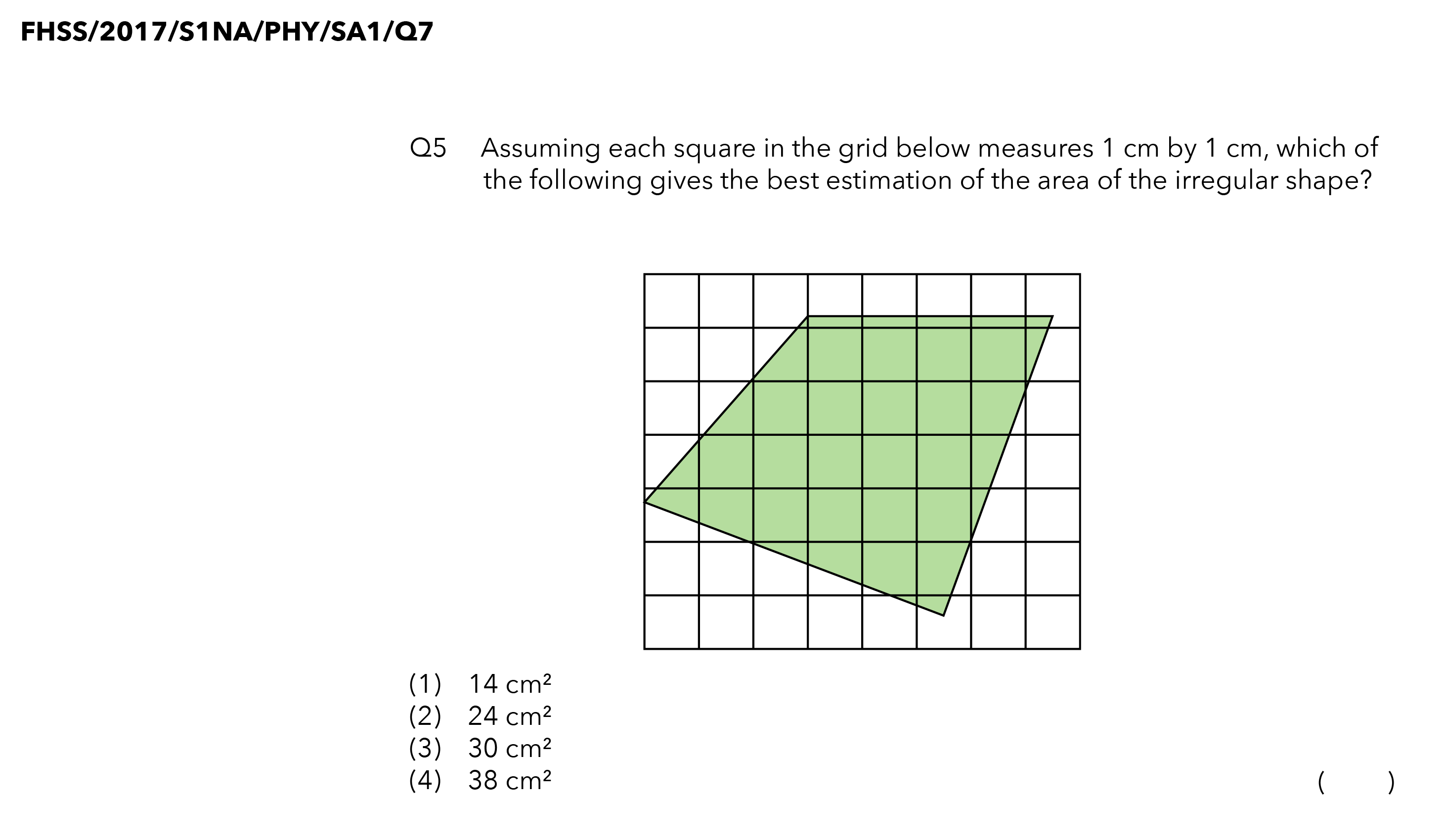
Source: Fuhua Secondary School – 2017 Physics S1NA SA1 Examination Paper [Q7]
In cases wherein the object has an irregular shape, it is not possible for us to use a formula.
So what are we going to do?
We can trace the outline of the object on graph paper or any paper with grid boxes as shown in the diagram below.
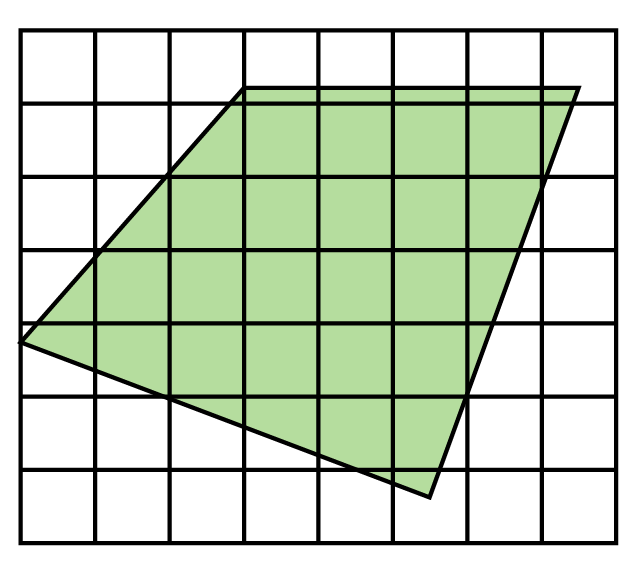
Source: Fuhua Secondary School – 2017 Physics S1NA SA1 Examination Paper [Q7]
Once we have traced out the outline of the irregular-shaped object, we can follow the following steps!
Step 1
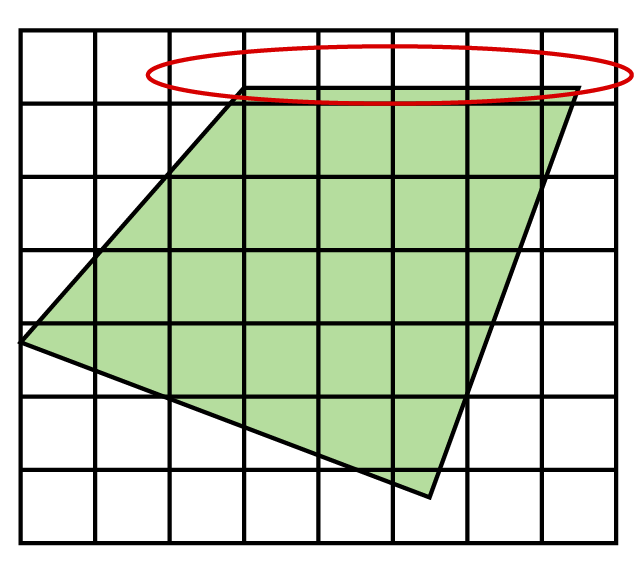
Count the number of boxes where the object has occupied more than half of the area of the grid box.
Let us look at the first row.
Source: Fuhua Secondary School – 2017 Physics S1NA SA1 Examination Paper [Q7]
Are there any boxes where the object occupied more than half of the area?
No! So we are not going to count any of the boxes in the first row.
Now let us begin counting the boxes from the second row onwards.
🏅 Tip When Counting The Boxes 🏅
Instead of a tick, use numbers to label the boxes where the object occupies more than half of the space. This helps you save time because in case you lose count, you won’t have to start counting all over again!
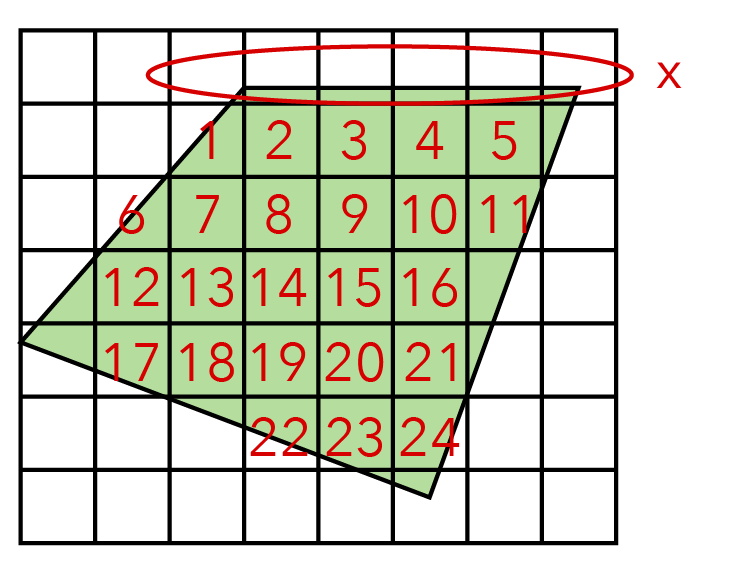
There are 24 boxes!
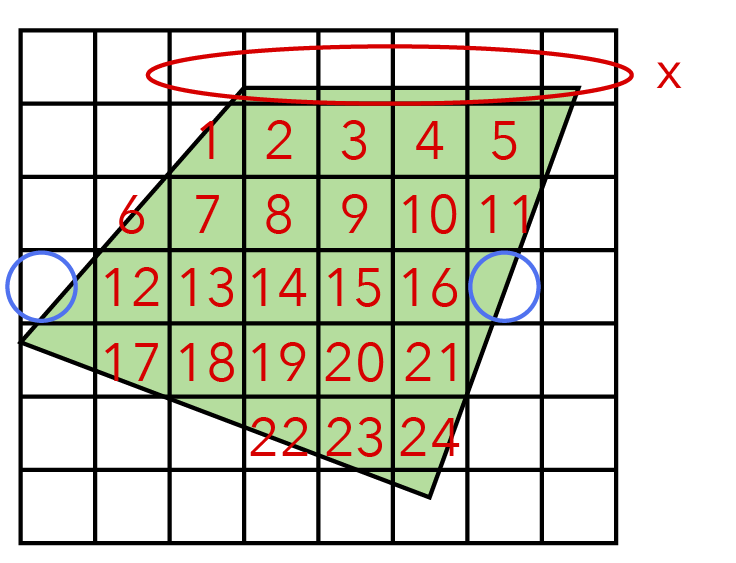
Some of you may be wondering if you can take the encircled boxes together to form one box.
As tempting as that is, the answer is no! This is actually a common error made by many students.
🔢 Remember This When Counting The Boxes 🔢
We cannot count any box where the area is only less than half-filled.
Let us move on to the next step.
Step 2
Find the area of each box.
Let us check the dimensions given in the question.
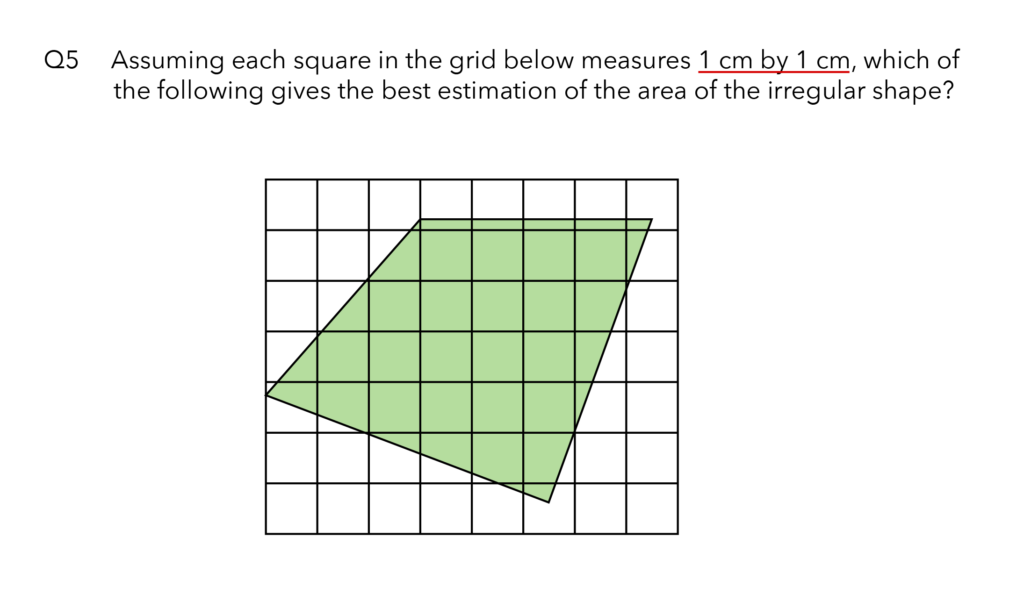
Source: Fuhua Secondary School – 2017 Physics S1NA SA1 Examination Paper [Q7]
It’s 1 cm by 1 cm.
So what’s the area of each box?
It is 1 cm2 .
Step 3
Multiply the number of boxes we counted in step (1) and the area of each box that we computed in step (2).
24 x 1 cm2 will give us 24 cm2.
Suggested Answer For Q7
Option (2)
Common Errors Made By Students
Remember to always check the area of each grid box. Do not assume that it’s always 1 cm2.
Some questions will trick you by giving boxes with different dimensions.
Let’s try changing the question now and make the size of each grid box 2 cm by 2 cm. What will be the estimated area of the figure?
The number of boxes where the object has occupied more than half of the area of the grid box remains 24.
Meanwhile, the area of each box will be 4 cm2.
24 x 4 cm2 = 96 cm2
Conclusion
Unlike regular shapes like circles and squares, you cannot use a formula when solving for the area of irregular shapes.
However, you can follow the three steps we listed above:
1️⃣ Count the number of boxes where the object has occupied more than half of the area of the grid box.
2️⃣ Find the area of each box.
3️⃣ Multiply the number of boxes we counted in step (1) and the area of each box that we computed in step (2).
Also, read the question carefully for the dimensions and do not assume that the area of each grid box is always 1 cm2.
Keep a lookout for more Secondary 1 Physics blog posts!