
Introduction
Just like you, plants need nutrients to grow healthily! But sometimes, they do not get enough nutrients because they have to “compete” with their “neighbours” — the plants near them!
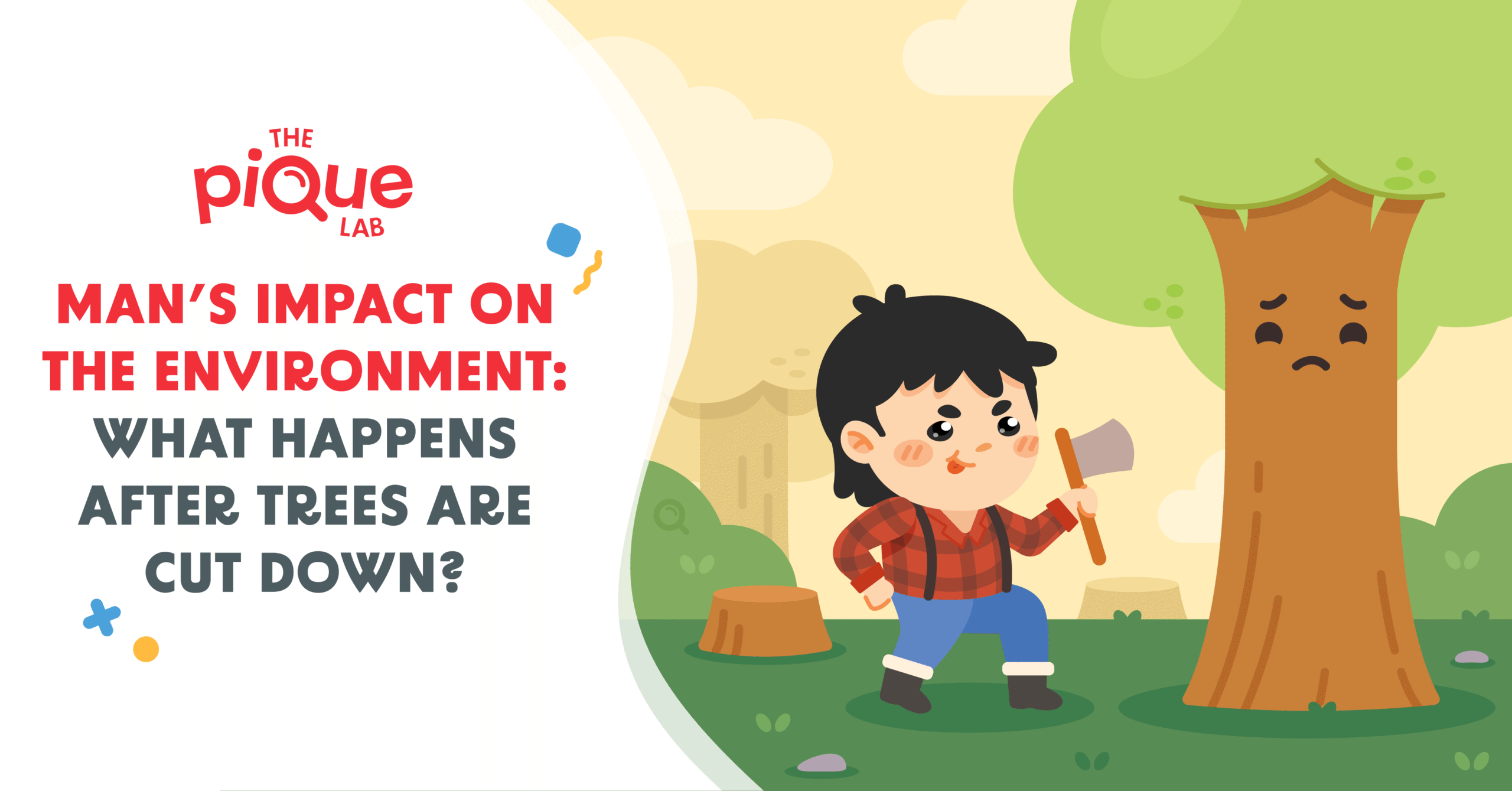
What do you think will happen to the smaller plants when the bigger trees surrounding them are cut down?
We will be answering this question on Man’s Impact on the Environment from the 2015 Nan Hua Primary School (NHPS) P6 SA2 Examination Paper in this article.
Let’s Take A Look At This Question

Source: Nan Hua Primary School – 2015 P6 SA2 Examination Paper [Q37]
Read Also:
Let’s Analyse Part (A)

Source: Nan Hua Primary School – 2015 P6 SA2 Examination Paper [Q37]
Why did the small plants struggle to grow well before the trees were cut down? Let’s imagine that small plants were growing alongside these trees in the forest.

It looks very crowded, doesn’t it? The plants are going to experience overcrowding.
There are four things that plants compete for. To help my students remember these four substances, I teach them that ‘We Must Share Snacks’.
🍿 Plants Compete For: We Must Share Snacks (WMSS) 🍿
💧 ‘W‘ stands for water.
🪨 ‘M‘ stands for mineral salts.
☀️ ‘S‘ stands for sunlight.
↔️ ‘S‘ stands for space.
Let’s go back to the small plants. When these plants are overcrowded and they’re competing with trees for water, mineral salts, sunlight, and space, can they grow healthily? No, the small plants cannot.
The question mentioned that the trees are now cut down, so let’s remove the trees in the picture.

Will these plants go through a lot of overcrowding?
There will still be overcrowding so we can’t state that the issue of overcrowding will be completely gone. But when the trees are cut down, the overcrowding issue is significantly reduced.
Therefore, there will be less competition between the small plants and the trees for ‘WMSS’ — “water, mineral salts, sunlight, and space”. This allows the small plants to grow healthily and well.
Suggested Answer For Part (A)
This reduces overcrowding, and reduces competition between the small plants and the trees for water, mineral salts, sunlight and space, allowing for healthier growth of the small plants.
Let’s Analyse Part (B)

Source: Nan Hua Primary School – 2015 P6 SA2 Examination Paper [Q37]
A label on the back of a birthday card says that it was made from wood taken from sustainable forests.
🌳 What Are Sustainable Forests? 🌳
In sustainable forests, new trees are planted to replace trees that are cut down.
Why is it important to replace forest trees that are cut down? Let’s think about the opposite first.
What happens when trees are cut down?
When trees are cut down, there will be fewer trees around, which means fewer trees going through this process called ‘photosynthesis‘.
When fewer trees go through photosynthesis there will be less carbon dioxide.
Because there’s less carbon dioxide taken in by the trees, more carbon dioxide is going to be in the surrounding air. And what kind of gas is carbon dioxide? It is a greenhouse gas..
🌞 What Do Greenhouse Gases Do? 🌞
Greenhouse gases trap heat from the sun.
However, now that there are more greenhouse gases accumulated in the air, they’re going to trap more heat from the sun and will cause global warming.

However, the question is asking for two reasons why it is important to replace forest trees. When we replace forest trees, there are going to be more trees around to take in carbon dioxide for photosynthesis to make food.
Therefore, since more trees are taking in carbon dioxide, there will be less carbon dioxide in the air. Remember, carbon dioxide is a greenhouse gas.
Less greenhouse gases will lead to less heat trapped from the sun. This leads to less global warming, which is a good thing.

What can be another reason? Let’s think about what happens when forest trees are cut down. Other than having fewer trees to take in carbon dioxide for photosynthesis, what’s another issue that’s going to occur?
If there are fewer trees, there are going to be fewer roots of trees to hold the soil together.
Furthermore, if there are fewer trees around, more soil is going to be exposed directly to the rain. This means that when it rains, the rainwater will land directly on the soil.
What happens to all the soil that is exposed?
❓What Is Soil Erosion❓
Exposed soil is washed away by the rain. This is what we call ‘soil erosion‘.

Soil erosion will occur if there are fewer trees around.
But once again, we are not talking about fewer trees because the question is about replacing forest trees. There are going to be more trees. Having more trees means having more roots to hold the soil together.

On top of these roots holding the soil together, since there are more trees around, less soil will be exposed to the rain. This means there will be less soil erosion because less soil is being washed away by the rain.
Suggested Answer For Part (B)
Reason 1: Replacing forest trees that are cut down results in more trees taking in carbon dioxide for photosynthesis to make food. Thus, there would be less carbon dioxide in the surrounding air, which is a greenhouse gas, trapping less heat from the sun, and reducing the effects of global warming.
Reason 2: Replacing forest trees that are cut down results in more roots of the trees to hold the soil together. Additionally, less soil will be exposed directly to the rain, causing less rainwater to land on the soil directly. Thus, less soil will be washed away by the rain, reducing soil erosion.
Conclusion
I hope that after reading this blog post, you have gained a stronger understanding of how overcrowding affects not only humans but also plants.
Remember these four things that plants compete for in crowded environments — Water, Mineral salts, Sunlight, and Space. (Keep in mind, We Must Share Snacks!)
Stay tuned for more Man’s Impact On The Environment paper analyses coming your way! 🙂