
Welcome back to our Examination Paper Analysis series!
Recently, one of my students shared with me that he encountered difficulties while attempting this interesting experiment-based question from the 2019 P6 Rosyth School (ROSYTH) Prelim Examination Paper.
This question is about finding out how the amount of dissolved oxygen in water affects various types of organisms in the water, which I would share and discuss with everyone in today’s blog post!
We have been learning that organisms need to take in oxygen for respiration to release energy to survive. However, do ALL organisms need oxygen to survive, and if not, which organism does not?
Do read on to find out! 🙊
Question Analysis
Let’s take a look at Q14.
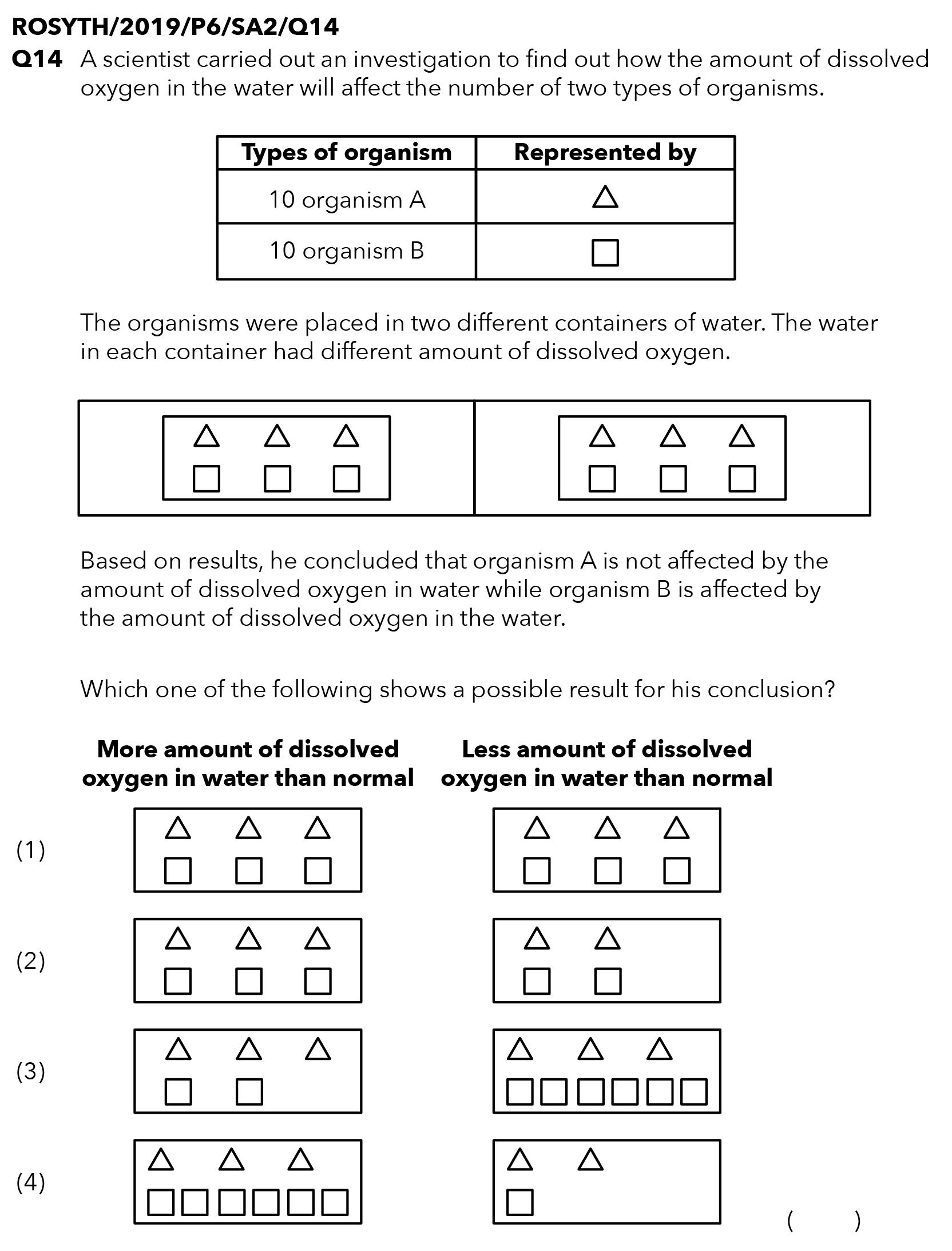
Source: Rosyth School – 2019 P6 Prelim Examination Paper [Q14]
Thought Process
Here is a brief summary of what this question is about:
- This is an experiment-based question on how the amount of dissolved oxygen in water affects various types of organisms in the water.
- The organisms are placed in two containers, one with more dissolved oxygen than normal and the other one with less dissolved oxygen than normal.
- Students are then asked to choose the option that best represents the number of organisms left in each container with different amounts of oxygen.
After reading the question, does anyone have their answer in mind yet? For those with an answer in mind, were you all deciding between options (2) and (4)?
If you did, am I right to say that your thought process is as follows?
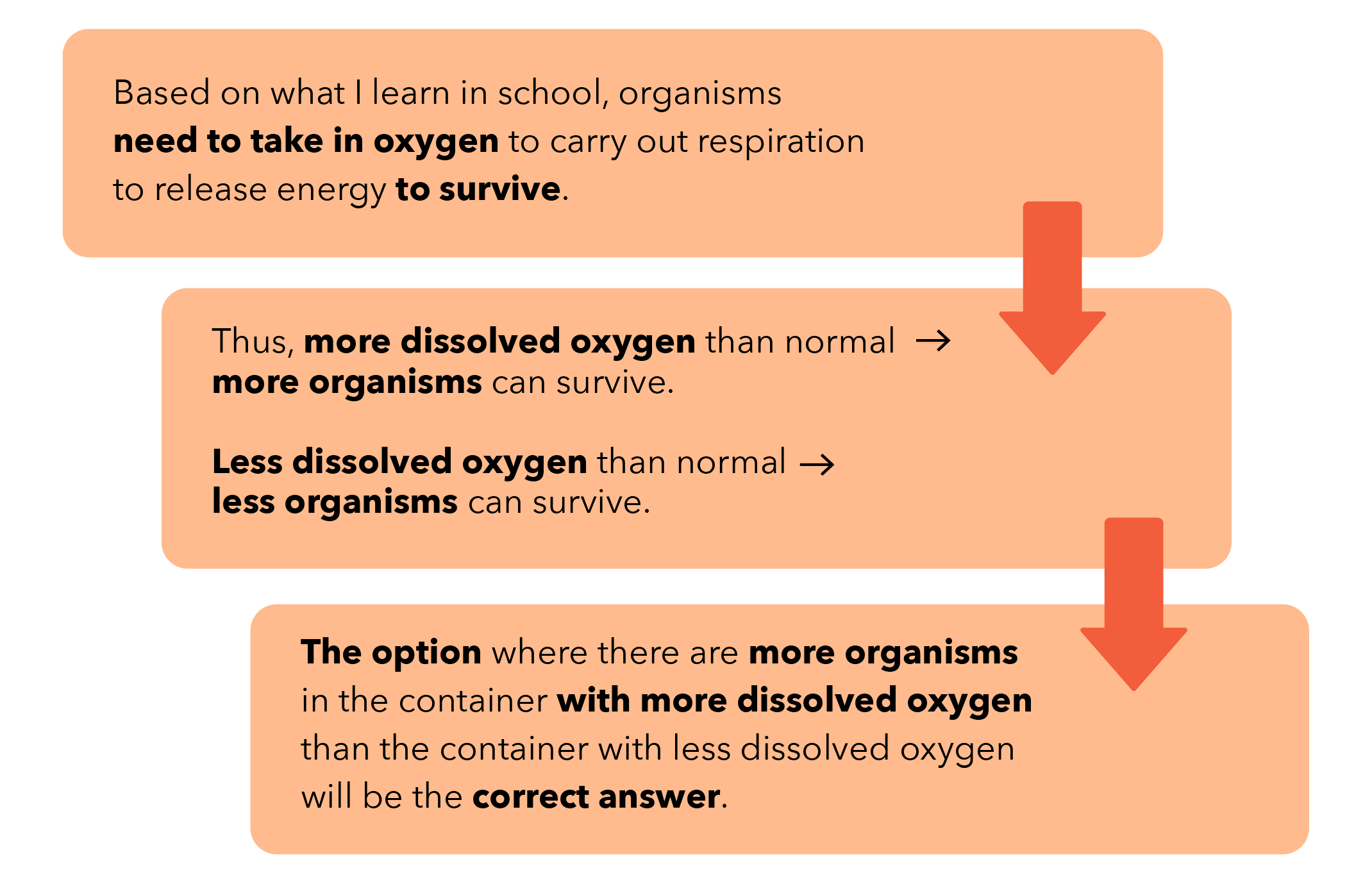
For those of you who chose either (2) or (4) as the answer, sadly, both options are incorrect!
What is wrong with the thought process above in answering this question?
The crux is that you answered the question using your own knowledge and DID NOT use the information given in the question, leading you to apply the wrong concepts to this question.
Thus, to avoid using the wrong concepts, I always advise my students to execute the following steps when tackling questions:
- Identify and highlight the keywords/key phrases in the question
- Link the keywords to the science concepts involved
Step 1: Identify & Highlight The Keywords/Key Phrases In The Question
“What are the important keywords/key phrases in the question that we should highlight and look out for?”
Give it a try and see if you can get the same keywords/key phrases as me:

A – “Based on results”
B – “organism A (triangle) is NOT affected by the amount of dissolved oxygen”
C – “organism B (square) is affected by the amount of dissolved oxygen”
D – “possible result for his conclusion”
⭐️ Tip: Highlighting keywords/key phrases allows us to zoom in on the hints provided in the question, make inferences from the hints and answer the question accurately! 😊
Step 2: Link The Keywords/Key Phrases To The Science Concepts Involved
A – Based on results
“Based on results” is the key phrase to look out for in an experiment-based question.
This key phrase allows us to identify the lessons learnt from the results of the experiment, which is also known as the conclusion of an experiment.
What is the conclusion obtained from this experiment then?
B – “organism A is NOT affected by the amount of dissolved oxygen”
Since the conclusion is that organism A (triangle) is NOT affected by the amount of dissolved oxygen in the water, what result should I have obtained to come up with this conclusion?

C – “organism B is affected by the amount of dissolved oxygen”
Since the conclusion is that organism B (square) is affected by the amount of dissolved oxygen in the water, what result should I have obtained to come up with this conclusion?

D – “possible result for his conclusion”
What is a conclusion?
As explained under key phrase A, “conclusion refers to the lessons that can be learnt from the results of the experiment.”
Since we have identified the conclusion of this experiment from key phrases B and C, and we have also inferred the corresponding experiment results based on the conclusion, we will now proceed to choose the correct option.
Final Analysis
As identified from above, since the number of organism A (triangle) should stay the same in the two containers with different amounts of dissolved oxygen, we can eliminate options (2) and (4).
Also, since we have identified from above that the number of organism B (square) should be different in the two containers with different amounts of dissolved oxygen, we can then eliminate option (1) as well.
The correct answer will then be option (3).
Do ALL Organisms Need Oxygen For Survival?
Remember I shared at the start of the blog post that I was going to reveal whether ALL organisms need oxygen for survival?
As of a few years ago, the answer was still a “yes”, as all of us believe to be so.
But from the year 2020 onwards, be prepared to be mind blown: the answer is now “NO”! 🤯
Just in the year 2020, one special organism that does not need oxygen for survival was finally discovered!

Spores of the parasite H. salminicola swimming under a microscope
This organism is named Henneguya salminicola, an 8-millimeter white parasite that infects the flesh of Chinook salmon.
In fact, it does not even breathe at all and can still survive!
⚠️ Note: The knowledge of this organism is NOT in the PSLE syllabus.
In the context of the PSLE syllabus, students should still take it as all living things need oxygen to survive, unless otherwise stated in the question.
If you would wish to read more about this special organism, you can click on the link here: https://www.livescience.com/first-non-breathing-animal.html
Moving Forward
I hope you have enjoyed reading this article and that this article has helped you gain a better understanding of:
- How to tackle experiment-related questions.
- Not all organisms require oxygen for survival.
Continue to keep a lookout for our new articles! 😊
Quiz about living things