

In today’s article, I’d like to share with you one of the answering techniques taught in our Experimental Techniques Masterclass.
We apply these techniques to tackle questions known as the “Conclusion Type Question“. I’d consider the Conclusion Type Questions to be the most complex amongst experiment-centric questions.
Read Also
Tackling the Conclusion Type Question in 4 Simple Steps
Step 1: Identify the changed variable.
Step 2: Identify the measured results.
Step 3: Interpret what the changed variable and measured results represent.
Step 4: Draw the link/relationship between the interpreted variables.
Question 1
What is the relationship between the distance between the lamp and the submerged hydrilla plant and the number of air bubbles produced?
Step 1: Identify the changed variable
Changed Variable: Distance between the lamp and the submerged hydrilla plant
Step 2: Identify the measured results
Measured Results: Number of air bubbles produced
Step 3: Interpret what the changed variable and measured results represent
Interpreted Changed Variable: The intensity of light
Interpreted Measured Results: Rate of photosynthesis
Step 4: Draw the link/relationship between the interpreted variables
The greater the intensity of light, the faster the rate of photosynthesis.
Question 2
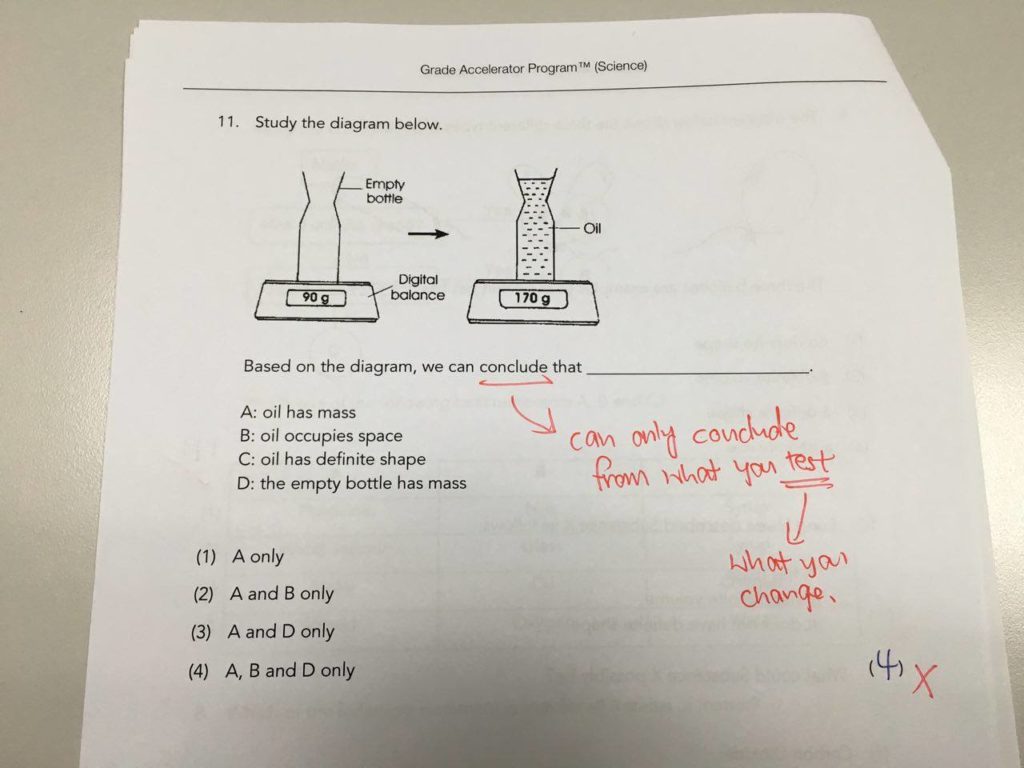
Remember: We can only conclude from the tested variable.
It is vital for students to remember this so as to avoid making the same assumption as seen in the question above.
In this question, the student made the assumption that the empty bottle caused the digital balance reading to show 90g.
However, do we know that the 90g reading is due to the empty bottle? (Perhaps, the empty bottle doesn’t affect the reading on the digital balance.)
In order to prove that the empty bottle has mass, another set-up with just the digital balance which reads 0g WITHOUT the empty bottle should be shown.
As such, we can only conclude with regards to the changed variable, which is the presence of the oil, and not any other variable in the experiment.
Therefore, the answer to this question then should be Option 2 (A & B only).

1 comment